How Caffeine, Alcohol and Screens Affect Your Sleep (And What to Do About It)
That afternoon coffee feels essential. The evening glass of wine helps you unwind. The phone in bed is just a quick scroll. These habits feel harmless because they’re everywhere. But each one acts on your sleep through a different biological pathway, and together they can turn what should be straightforward rest into a nightly struggle.
The issue runs deeper than feeling tired. Caffeine masks your need for sleep without removing it, leaving you wired but exhausted. Alcohol sedates you initially but dismantles the very sleep stages that restore your mind. Screen light delays your internal clock while the content keeps your brain in active problem-solving mode. By the time you actually try to sleep, your biology is working against you.
Understanding how these three inputs interfere with sleep gives you the practical knowledge to make deliberate trade-offs. You will see exactly what happens in your body when you have that 3pm espresso, why the nightcap backfires hours after you drink it, and what screen exposure does beyond just “blue light.” More importantly, you will learn specific timing windows and practical strategies that protect your sleep without requiring you to eliminate everything enjoyable.
This article explains the mechanisms, then focuses on what actually works. The goal is not perfection but informed choices that let you keep what matters while removing what costs you more than it delivers.
Why Caffeine Keeps You Awake Hours After You Drink It
Caffeine promotes alertness by blocking adenosine receptors in your brain. Adenosine accumulates while you are awake, building sleep pressure gradually throughout the day. After roughly 12 to 16 hours of wakefulness, adenosine levels are high enough to make you feel ready for sleep. Caffeine occupies the receptor sites where adenosine would normally bind, preventing the drowsiness signal from reaching your brain.
This creates an immediate problem: caffeine does not remove adenosine. The chemical continues to build while caffeine blocks the signal. When caffeine eventually clears from your system, accumulated adenosine floods the receptors all at once. This produces the familiar “caffeine crash” where tiredness hits harder than it would have without the stimulant.
The Half-Life Problem Most People Ignore
Caffeine has a half-life of approximately five to six hours in most adults, though individual metabolism varies significantly based on genetic factors. Half-life means that after six hours, half of the caffeine remains in your system. After another six hours, a quarter remains.
Consider a 200mg coffee consumed at 2pm. By 8pm, roughly 100mg remains. By 2am, approximately 50mg is still circulating. That residual caffeine continues blocking adenosine receptors throughout the night, even though you no longer feel alert. Sleep studies show this lingering caffeine lengthens the time needed to fall asleep, reduces total sleep duration, and decreases the amount of deep sleep your brain achieves.
Deep Sleep Takes the Biggest Hit
Research demonstrates that caffeine can reduce deep sleep by 15 to 30 percent, even in people who report “sleeping fine” after evening caffeine. Deep sleep drives physical restoration, immune function strengthening, and memory consolidation. Losing this stage leaves you feeling unrefreshed despite adequate hours in bed, which often leads to reaching for more caffeine the next morning. The cycle reinforces itself. This is why determining how much sleep you actually need must account for both quantity and quality.
Some individuals metabolize caffeine faster due to specific enzyme variants, clearing it within three to four hours. Others are slow metabolizers, retaining significant caffeine for 10 to 12 hours or longer. Most people do not know which category they fall into. The safest assumption is that caffeine consumed after early afternoon will affect your sleep.
What to Do About Caffeine
Set a firm cut-off time. For most people, avoiding caffeine after midday to 2pm protects evening sleep. If you struggle with sleep onset or wake frequently in the early morning hours, push the cut-off earlier to mid-morning.
Track your actual intake. A standard cup of coffee contains 80 to 100mg of caffeine, but larger servings from coffee shops often contain 200 to 300mg. Tea, energy drinks, pre-workout supplements, and even chocolate contain meaningful amounts. “Decaf” coffee is not caffeine-free; it typically contains 5 to 15mg per cup, which can add up across multiple servings.
Replace strategically. If you rely on afternoon caffeine for a performance boost, consider alternatives that do not interfere with adenosine signaling. A brief walk outdoors, cold water on your face, or a 10 to 20 minute nap in the early afternoon provides genuine energy without the sleep cost. If you must have caffeine later in the day, minimize the dose and drink it as early as possible.
Accept the withdrawal period. Reducing caffeine intake often produces headaches, irritability, and fatigue for three to five days as your brain readjusts to natural adenosine sensitivity. Taper gradually rather than stopping abruptly. The temporary discomfort is worth the long-term improvement in sleep quality.
How Alcohol Dismantles Your Sleep Architecture
Alcohol functions as a sedative, which many people mistake for a sleep aid. Sedation and natural sleep are fundamentally different processes. Sleep involves highly coordinated brain activity across multiple stages, each serving distinct restorative functions. Sedation suppresses brain activity indiscriminately, producing unconsciousness without the structured cycles your body requires.
The Three-Stage Disruption
Alcohol damages sleep through three mechanisms. First, it activates your sympathetic nervous system, the fight-or-flight response that should be dormant at night. This keeps your body in a state of partial arousal, making sleep fragmented and light. You may not remember waking, but studies using objective sleep tracking show that alcohol increases awakenings by 94 percent in the final four hours of the night compared to sober sleep.
Second, alcohol triggers the release of cortisol, a stress hormone that further stimulates arousal centers in your brain. This compounds the sympathetic activation, making sustained, continuous sleep nearly impossible even though you initially lost consciousness quickly.
Third, and most damaging, alcohol severely impairs REM sleep. As your liver metabolizes alcohol, it produces byproducts called aldehydes and ketones. These metabolites directly block the brain mechanisms that generate REM sleep, particularly during the first half of the night when alcohol levels are highest.
REM Sleep Suppression and Rebound
REM sleep processes emotional experiences, consolidates complex memories, and integrates new learning with existing knowledge. When alcohol suppresses REM early in the night, your brain attempts to compensate later through a “REM rebound” once alcohol clears. This rebound produces vivid, often disturbing dreams and frequent awakenings in the early morning hours.
The net result is less total REM across the entire night and poorer quality REM during the rebound period. This impairs next-day emotional regulation, memory performance, and cognitive function. Even moderate drinking produces measurable deficits.
Clearance Timing Makes It Worse
Your body metabolizes alcohol at a roughly constant rate of approximately one standard drink per hour, though individual variation is significant. A standard drink in the UK contains about 10 grams of pure alcohol. Three to four drinks consumed across an evening can leave measurable alcohol in your system into the early morning hours, precisely when REM sleep should dominate.
This timing guarantees suppression during the first sleep cycles and fragmentation during later ones. The closer alcohol consumption is to bedtime, the more severe the REM loss and the greater the fragmentation.
Additional Sleep Disruptions
Alcohol relaxes upper airway muscles, worsening snoring and increasing the likelihood of breathing pauses during sleep. It also causes vasodilation, widening blood vessels and raising skin temperature. This interferes with the natural core body temperature drop required for consolidated sleep, leaving you overheated and restless.
What to Do About Alcohol
The ideal approach for sleep quality is to avoid alcohol in the evening entirely. If you choose to drink, apply strict boundaries.
Stop drinking three to four hours before your intended bedtime. This gives your body time to clear most of the alcohol before REM-dominant sleep stages begin. Earlier is better.
Limit total intake. Keep consumption to one to two standard drinks maximum if sleep quality matters to you that night. More drinks extend the clearance time and intensify all three disruption mechanisms.
Hydrate deliberately. Alcohol is a diuretic, increasing nighttime trips to the bathroom and contributing to that groggy, unrefreshed feeling in the morning. Drink water alongside alcohol and before bed.
Monitor your patterns. Use a sleep tracker or keep a simple log noting alcohol intake, sleep onset time, and how you feel the next morning. Objective data often reveals impacts you have normalized. Many people discover they feel dramatically better on alcohol-free evenings.
Do not use alcohol to cope with stress or sleep problems. This creates a self-reinforcing cycle where poor sleep drives alcohol use, which further degrades sleep and increases anxiety. If you find yourself relying on alcohol to fall asleep, understanding common sleep problems and seeking professional help can address the underlying issue.
How Screen Light and Content Keep Your Brain Active
Screens disrupt sleep through two separate pathways. The first involves light wavelength and intensity. The second involves the arousing nature of the content itself. Both matter, and simply reducing blue light addresses only half the problem.
Light Suppresses Melatonin and Delays Your Clock
Your eyes contain specialized cells called melanopsin-containing retinal ganglion cells that detect light and send timing signals to your brain’s master clock, the suprachiasmatic nucleus. This system evolved to track sunrise and sunset, synchronizing your internal rhythms with the 24-hour day. This is why controlling light in your sleep environment matters so much for maintaining proper circadian timing.
Light in the blue and green wavelength range (400 to 520 nanometers) has the strongest impact on this system. Evening exposure to these wavelengths suppresses melatonin production, the hormone that signals your body to prepare for sleep. It also shifts your circadian timing later, making you feel alert when you should be winding down.
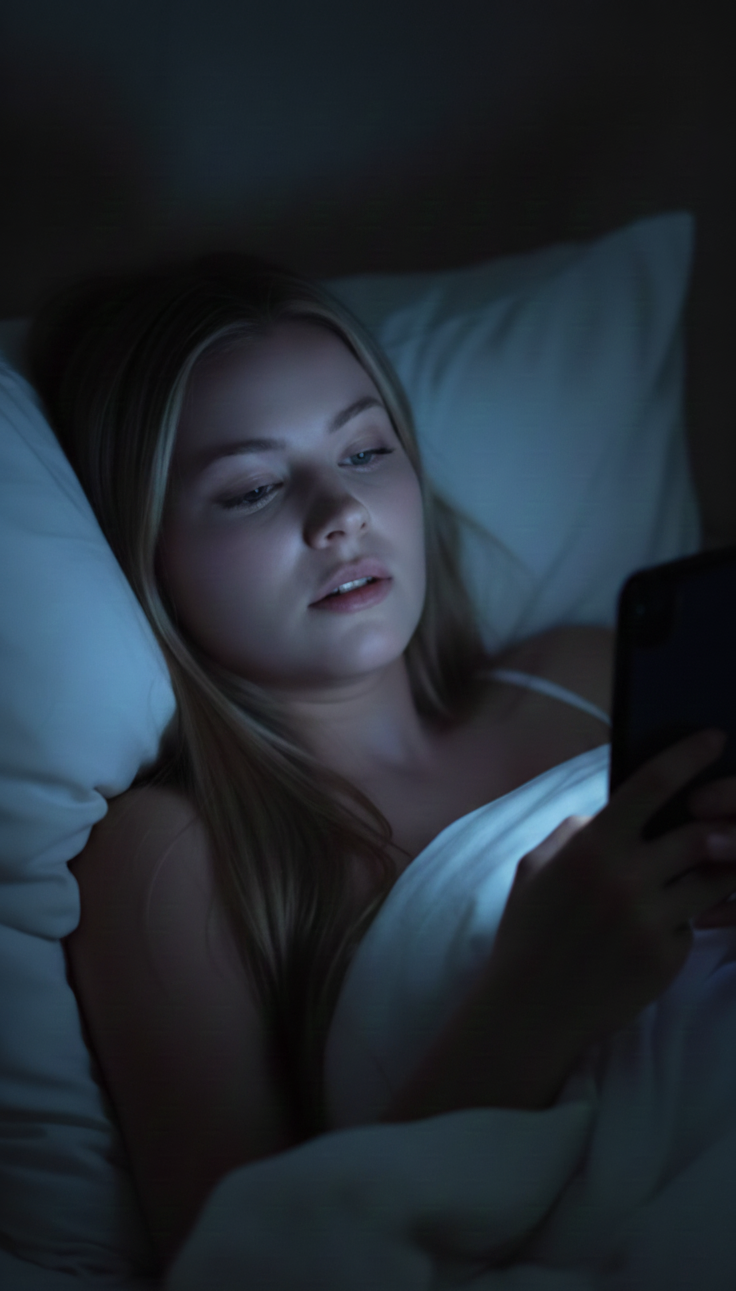
Brightness matters, but proximity matters more. A smartphone held 30 centimeters from your eyes delivers more effective light stimulus than a larger screen across the room, even if the distant screen is brighter overall. Your retinas are most sensitive during nighttime hours, so even brief exposure late at night can suppress melatonin for hours afterward.
Content Activates Your Brain Regardless of Light
Blue light filters, night mode settings, and dimmed screens reduce the circadian disruption from light wavelength. They do nothing about the cognitive and emotional arousal generated by engaging content.
Scrolling social media, reading work emails, watching dramatic shows, or playing interactive games keeps your prefrontal cortex active in problem-solving and decision-making mode. Your brain treats these activities as important waking tasks, releasing alerting neurochemicals and maintaining a state incompatible with sleep onset. This is why you can feel “wired” even with all the blue light filters active.
The combination is particularly damaging. Late evening screen use delivers both circadian disruption from light and cognitive arousal from content. Your brain receives conflicting signals: the time of day suggests it is late, but the light and engagement signal that important waking activity is still underway.
What to Do About Screens
Eliminate screens during the wind-down period. Aim for a complete screen-free window of 30 to 60 minutes before bed. This is the single most effective intervention. Park your phone outside the bedroom, turn off the television, and avoid “just checking” anything. This screen-free window should be part of a structured bedtime routine that signals your body it’s time for sleep.
If you must use screens in the evening, apply damage control strategies:
Reduce brightness significantly. Dim displays to the lowest comfortable level. Brightness has a dose-response relationship with melatonin suppression.
Increase distance. Use devices across the room rather than close to your face. This reduces the effective light exposure reaching your retinas.
Use red-shifted lighting. Evening environments should favor warm, low-intensity lighting. Replace bright overhead lights with dimmed lamps using warm-toned bulbs. Red wavelengths have minimal impact on melatonin compared to blue and green.
Choose passive, low-arousal content if you must engage. Avoid work tasks, news, social media, or anything that provokes strong emotional responses. Stick to familiar, calming content that does not demand active problem-solving.
Consider specialized filtering eyewear for evening use only. Products designed to block both blue and green wavelengths provide superior protection compared to standard blue light glasses. Use these only in the final hours before bed, not throughout the day. Morning and daytime blue light exposure supports circadian health and alertness.
Create structural barriers. Charge your phone in another room. Delete social media apps from your bedroom devices. Set app timers that lock you out after a certain hour. Make late-night screen use inconvenient rather than relying on willpower.
The Interaction Effects You Cannot Ignore
Caffeine, alcohol, and screens do not act in isolation. They compound each other’s effects in ways that make sleep problems harder to trace to a single cause.
Evening screen light delays your circadian timing, which extends the window during which residual caffeine feels alerting. A coffee at 2pm might not disrupt sleep when your circadian system is strong and properly timed, but the same coffee becomes problematic when evening light has pushed your internal clock later.
Alcohol sedates you enough to fall asleep despite residual caffeine and screen-induced arousal, creating the illusion that you are “sleeping fine.” In reality, the combination produces severely fragmented sleep with minimal REM and reduced deep sleep. You wake feeling terrible but attribute it to stress or poor mattress rather than the accumulated impact of all three inputs.
This is why isolated interventions often fail. Cutting caffeine at 2pm helps, but not if you drink wine at 9pm and scroll your phone in bed. Each behavioral change amplifies the others when applied together.
Practical Implementation: Where to Start
Week 1: Set your caffeine cut-off. Choose midday or 2pm as your last meaningful caffeine intake. Track how this affects your sleep onset time and morning alertness over seven days.
Week 2: Remove screens from the bedroom. Charge your phone outside your sleeping space. Use an alarm clock if needed. Replace evening screen time with reading a physical book or another non-glowing activity.
Week 3: Establish an alcohol boundary. If you drink in the evening, stop three to four hours before bed. Log how you feel the next morning. Compare evenings with alcohol to alcohol-free evenings.
Week 4: Optimize evening light. Dim overhead lights after 8pm. Use warm-toned lamps. If you must use screens, maximize distance and minimize brightness.
Apply these sequentially rather than attempting everything at once. Each intervention becomes easier when the previous ones are already working. After four weeks, you will have concrete data showing which changes deliver the most meaningful improvements for your specific patterns.
Frequently Asked Questions
Does caffeine affect everyone’s sleep the same way?
Caffeine metabolism varies significantly based on genetic enzyme variants. Some people are fast metabolizers who clear caffeine within three to four hours, while slow metabolizers retain it for 10 to 12 hours or longer. Most people fall somewhere in the middle with a five to six hour half-life. Even fast metabolizers should avoid caffeine after early afternoon if sleep quality matters, as residual amounts can still reduce deep sleep by 15 to 30 percent without causing obvious difficulty falling asleep.
Can I drink alcohol earlier in the evening without affecting my sleep?
Stopping alcohol consumption three to four hours before bedtime reduces but does not eliminate sleep disruption. Your body metabolizes roughly one standard drink per hour, so multiple drinks will extend clearance time into the night. Alcohol still suppresses REM sleep in the first half of the night even with earlier timing, and the rebound effect later causes fragmentation. The safest approach for optimal sleep is avoiding alcohol on evenings when sleep quality is a priority.
Are blue light blocking glasses enough to fix screen-related sleep problems?
Standard blue light blocking glasses filter only part of the problematic wavelength spectrum and do nothing about the cognitive arousal from engaging content. Specialized filtering eyewear that blocks both blue and green wavelengths (400 to 520nm range) provides better protection but should be combined with content choices that avoid activating your problem-solving brain. The most effective intervention remains eliminating screens entirely during your wind-down period.
Why do I fall asleep easily after drinking but wake up at 3am?
Alcohol functions as a sedative, causing rapid unconsciousness that feels like sleep. As your liver clears the alcohol over several hours, the sedative effect wears off while metabolic byproducts like aldehydes stimulate your sympathetic nervous system and suppress REM sleep. This combination produces the characteristic pattern of quick sleep onset followed by fragmented, restless sleep and early waking. The timing typically coincides with the final hours of the night when REM sleep should dominate.
How long does it take to see sleep improvements after cutting out caffeine?
Most people experience noticeable sleep improvements within three to seven days of establishing a consistent caffeine cut-off time. The first few days may feel difficult as your brain readjusts to natural adenosine sensitivity, often producing temporary headaches and fatigue. After this adjustment period, sleep onset typically becomes faster, deep sleep increases, and morning alertness improves as you rely less on stimulants to compensate for poor sleep quality.
Small Changes, Measurable Results
The way caffeine, alcohol, and screens affect your sleep is not mysterious or unpredictable. Each input acts through specific biological mechanisms with well-documented timing windows and dose-response relationships. This means you can make targeted interventions and expect consistent results.
Start with the intervention that feels most achievable. For many people, that means establishing a caffeine cut-off time since it requires minimal disruption to evening routines. Others find removing screens from the bedroom easiest because it simply involves changing where they charge their phone. The specific order matters less than consistent execution.
What you will discover after implementing these changes is that sleep becomes straightforward again. You feel genuinely sleepy at an appropriate hour. You fall asleep within 15 to 20 minutes. You wake fewer times, or return to sleep quickly when you do wake. Morning alertness improves without requiring immediate caffeine. These outcomes emerge naturally when you stop fighting your biology.
The trade-offs are real. Evening caffeine provides genuine alertness benefits, and late-night scrolling offers dopamine hits and social connection. But both cost you more than you are gaining. Understanding the mechanisms lets you make informed choices about which inputs you genuinely value versus which ones you have simply normalized.
Understanding why sleep is so important makes these trade-offs clearer. Your sleep architecture depends on properly timed signals from light, clear adenosine receptors, and intact REM cycles. Caffeine after midday, alcohol within four hours of bed, and screens during wind-down time all interfere with these requirements. Remove these obstacles and your natural sleep systems handle the rest.